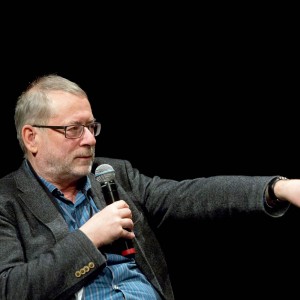
Kongjian Yu in a playful exchange at Les Machines de l'Ile on the occasion of the IFLA GALA Dinner in Nantes, September 12
Kongjian Yu and the Sponge
The news of Kongjian Yu’s sudden death two weeks later sent shockwaves not only through the nearly 1,500 participants of the congress in Nantes, but through the entire landscape architecture community worldwide. Many, myself included, had known him for more than two decades, meeting him at ASLA Annual Meetings, the Barcelona Biennale, the World Architecture Festival, IFLA congresses, and countless other events. Tirelessly, he travelled from continent to continent, spreading and promoting his projects and ideas. One can fairly say that his ability to communicate — and to give his work global visibility — was extraordinary.
Yu’s lasting contribution was to bring methods of water retention and urban water management into mainstream landscape practice at scale, realizing them in hundreds of projects, initially across China. His 2018 book Letters to the Leaders of China documents his sustained political work — often years of patient conversations with mayors and decision-makers. “Design is a political and social process,” he liked to say. “You have to convince the leaders.”
In his lectures, Yu frequently referred to land-use traditions from his rural childhood — a “traditional wisdom” that shaped his thinking. His lecture titles alone often revealed his approach: “The Art of Survival” or “Creating Deep Forms in Urban Nature: The Peasant’s Approach.”
Around 2009, journals such as Topos, Garten + Landschaft and LA China reported on the Gowanus Canal Sponge Park in Brooklyn, a project by landscape architect Susannah C. Drake and DLANDstudio. Drake even registered “Sponge Park” as a trademark in 2008. Yu recognised the communicative power of the “Sponge” label — and strategically adopted it to unify his body of work under a single, vivid idea. It worked: today, he is widely referred to as the father of the Sponge concept. (Susannah Drake’s book Sponge Park on the Gowanus Canal Project was published in October 2024.)
Endangered Pantanal
The Pantanal in Brazil is the largest inland wetland on Earth and home to extraordinary biodiversity. Only a small part of it is protected as a UNESCO World Heritage site. Today, less and less water from the Amazon and Cerrado reaches this fragile ecosystem. The Pantanal is drying. Devastating fires in 2020 and 2024 — often set deliberately by people — have accelerated the damage. Powerful cattle ranchers seek to expand pastureland for ever larger herds. Under former president Bolsonaro, illegal land seizures were often met with approval. Environmental activists are regularly silenced.
For Yu, the Pantanal was more than a landscape — it was a model for the retention systems he developed in his projects. He was preparing a documentary film about the region. Just days after his appearance at the São Paulo Architecture Biennale, Yu boarded a Cessna with two documentary filmmakers to fly over the Pantanal. The plane went down during an aborted landing attempt. All on board were killed.
IFLA World Congress — Guiding Landscapes
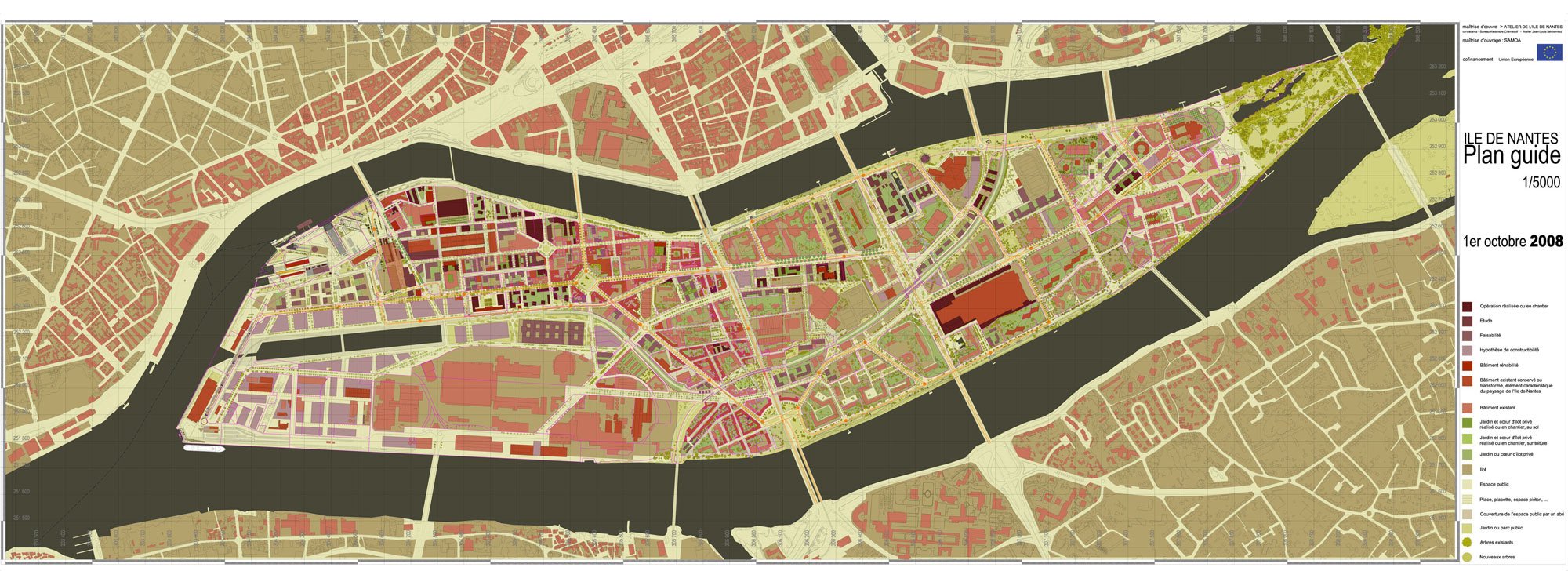
The 61st congress theme, Guiding Landscapes, was a statement of ambition: to position landscape architecture as a leading force in shaping the built environment. It also alluded to the internationally renowned Plan Guide for the Île de Nantes.
Plan Guide, Alexandre Chemetoff, 2008
For centuries, shipyards and factories on this island in the Loire were central to Nantes’ growth as a commercial hub near the Atlantic. When the last ship — the Bougainville — left the slipway in 1987, a new era began: 337 hectares of industrial land were to be transformed. Instead of a rigid master plan, an open, iterative process was chosen. Alexandre Chemetoff and Jean-Louis Berthomieu led the first phase (2000–2010), followed by Anne Mie Depuydt and Marcel Smets (2010–2016), and then Jacqueline Osty and Claire Schorter.
This “plan guide” method was described by Chemetoff as “a sum of living experiences — a way to invent the project during its realisation, as it is inscribed into public space.” Public space became the connective tissue, the driving factor behind the transformation.
If the first IFLA World Congress in 1987 in Paris could be summed up under laissez-faire, the 2025 congress in Nantes impressed with its clarity, calm organisation, excellent timekeeping, generous hospitality, and the extraordinary energy of dozens of volunteers. Nantes was chosen as a venue precisely because landscape has here proven itself as an urban catalyst: parks and green spaces have grown in step with the city’s transformation.
Henri Bava, president of the French professional association FFP, noted with regret that despite increased recognition, the professional title in France remains paysagiste concepteur rather than architecte paysagiste — “landscape architect.” Given the current political climate in France, the momentum generated by the congress is unlikely to lead to formal change in the short term.
The congress, as always, had two layers: the official lectures, and the meetings of IFLA’s Executive Committee and World Council — its political engine room. It is here that strategies and policies are set, often communicated to members only after the fact through national associations.
A key announcement was the launch, in 2026, of the IFLA Global Awards Program, intended “to further elevate the profile of the profession and celebrate the outstanding contributions of landscape architects worldwide.” According to IFLA, it will be the first truly international awards program. In addition, a Knowledge Hub has been established as a shared platform for professional resources.
IFLA Awards 2025
Two awards were celebrated during the congress: The Jellicoe Award, IFLA’s highest honour, went to Günther Vogt, who had earlier this year received the LILA Honour Award. The jury stated: “Günther Vogt is one of the most influential landscape architects and his lifetime achievements, both in practice and theory, have had a profound and lasting impact on the global advancement of landscape architecture.” His work — grounded in interdisciplinary thought and context — underscores the cultural significance of the profession. His teaching and commitment to bridging academia and practice have had a lasting global influence. The President’s Award was awarded to Hal Moggridge (UK).
Notes from the Lecture Programme
Among the many lectures, several stood out:
Dirk Sijmons, co-founder of H+N+S Landscape Architects, delivered “Navigating the Waves of the Anthropocene.” He distinguished four contemporary attitudes toward the Anthropocene: Denialism, Ecomodernism, Posthumanism, and New Anthropocentrism — each a well-marked philosophical escape route from modernism. He argued that humanity, now a geological force, must confront the planetary processes it has altered.
Sijmons referenced Robert Wilson and, above all, Richard Weller — one of the field’s most influential figures, who died earlier this year at 61. Weller’s Atlas for the End of the World (2017, with Claire Hoch and Chieh Huang) sought to inform more intelligent land-use decisions and planning strategies.
Marc-André Selosse, microbiologist and professor at the Natural History Museum in Paris, turned the gaze inward: our bodies contain 1–2 kilograms of microbes. Biodiversity begins with us. Preserving soil health, he stressed, is crucial, as agriculture’s heavy use of pesticides and fertilisers has already caused severe damage. His message was simple: we need soil, plants — and especially trees, preferably native. Living far from green space correlates measurably with higher rates of neurological illness.
Cecil Konijnendijk, from the Nature Based Solutions Institute, connected to this idea with his now well-known 3-30-300 rule for urban forestry: – at least 3 trees visible from every home – 30% canopy cover in every neighbourhood – maximum 300 m from a larger green space.
Forest Urbanism — treating the city as a forest — is becoming a major theme in ecological urban transformation (Forest Urbanism, Bruno de Meulder & Kelly Shannon, eds., Leuven 2024). But living “in the forest” also raises legal and safety issues — notably around wildfire risk. Pepa Moran (University of Barcelona) spoke on “Landscapes and Risk of Fire — from Event to Regime.” Since 96% of wildfires are human-caused, wildfire management will become an integral part of urban forestry.
For the IFLA 2025, Henri Bava outlined three key themes for the congress and beyond: the living city, ecological transformation, and the central role of landscape architects in driving these processes. This remains a vital topic in positioning the profession within a transdisciplinary alliance to adapt to climate change.
The next IFLA Conference will take place in Hong Kong in October 2026.
Robert Schäfer, founder of Topos Magazine studied Landscape Architecture and Journalism, founded Topos in 1992 and was in charge of Garten+Landschaft since 1984. He currently deals with landscape issues and is supporting Landezine.
To provide the best experiences, we use technologies like cookies to store and/or access device information. Consenting to these technologies will allow us to process data such as browsing behavior or unique IDs on this site. Not consenting or withdrawing consent, may adversely affect certain features and functions.
Functional Always active
The technical storage or access is strictly necessary for the legitimate purpose of enabling the use of a specific service explicitly requested by the subscriber or user, or for the sole purpose of carrying out the transmission of a communication over an electronic communications network.
Preferences
The technical storage or access is necessary for the legitimate purpose of storing preferences that are not requested by the subscriber or user.
Statistics
The technical storage or access that is used exclusively for statistical purposes.The technical storage or access that is used exclusively for anonymous statistical purposes. Without a subpoena, voluntary compliance on the part of your Internet Service Provider, or additional records from a third party, information stored or retrieved for this purpose alone cannot usually be used to identify you.
Marketing
The technical storage or access is required to create user profiles to send advertising, or to track the user on a website or across several websites for similar marketing purposes.
To provide the best experiences, we use technologies like cookies to store and/or access device information. Consenting to these technologies will allow us to process data such as browsing behavior or unique IDs on this site. Not consenting or withdrawing consent, may adversely affect certain features and functions.
Functional Always active
The technical storage or access is strictly necessary for the legitimate purpose of enabling the use of a specific service explicitly requested by the subscriber or user, or for the sole purpose of carrying out the transmission of a communication over an electronic communications network.
Preferences
The technical storage or access is necessary for the legitimate purpose of storing preferences that are not requested by the subscriber or user.
Statistics
The technical storage or access that is used exclusively for statistical purposes.The technical storage or access that is used exclusively for anonymous statistical purposes. Without a subpoena, voluntary compliance on the part of your Internet Service Provider, or additional records from a third party, information stored or retrieved for this purpose alone cannot usually be used to identify you.
Marketing
The technical storage or access is required to create user profiles to send advertising, or to track the user on a website or across several websites for similar marketing purposes.